Neurocomputing • Volume 649 • 2025 • Article 130876
Constrained Unseen Recovery Estimator (CUR-Estimator)
Towards reliable missing data imputation for commercial aero-engine degradation process
Authors
Haoze Wu; Shisheng Zhong; Minghang Zhao; Xuyun Fu; Yongjian Zhang; Song Fu
Affiliations
- a. School of Mechatronics Engineering, Harbin Institute of Technology, Harbin 150001, China
- b. Department of Mechanical Engineering, Harbin Institute of Technology, Weihai 264209, China
- c. Weihai Key Laboratory of Intelligent Operation and Maintenance, Harbin Institute of Technology, Weihai 264209, China
Core Idea
The Constrained Unseen Recovery Estimator (CUR-Estimator) aims to improve the accuracy and stability of imputation under long consecutive missing segments in aero-engine life-cycle degradation data. The method enhances conventional multi-step imputation from two complementary perspectives. First, time interval information associated with missing segments is explicitly incorporated into multivariate time-series modeling, alleviating error accumulation caused by irregular sampling and recursive prediction. Second, statistical interpolation results are introduced as distributional priors during neural network training, imposing soft constraints on multi-step imputation outputs without enforcing hard boundary conditions, thereby suppressing prediction drift and yielding more stable and physically plausible recovery results.
CUR-Estimator at a glance
For consecutive missing segments in aero-engine operational data, single-step based imputation often suffers from multi-step error accumulation. CUR-Estimator integrates interval-aware temporal modeling into neural imputation and suppresses unrealistic prediction drift via statistical interpolation constraints. The effectiveness is validated on simulated engine data, real civil aero-engine datasets, and wind turbine datasets.
Problem
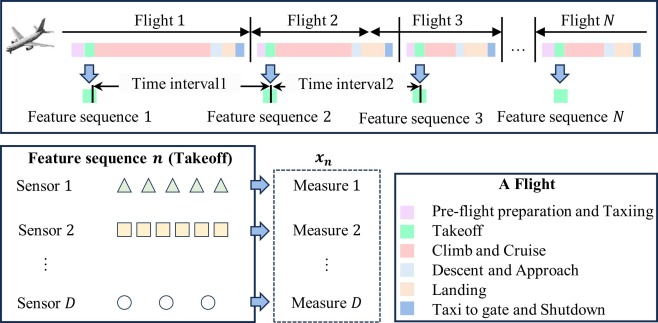
Sensor data collected from aero-engine operations inevitably contain missing values and noise. For consecutive missing segments along the temporal dimension, imputation strategies based on single-step prediction rely heavily on recursive forecasting, where errors accumulate and amplify as prediction horizons increase. Methods assuming uniform sampling intervals often fail to stably characterize degradation trajectories and may generate implausible imputation results.
Approach
A self-attention enhanced GRU network explicitly models irregular sampling intervals to enable interval-aware imputation. Statistical interpolation results are further introduced as soft constraints to restrict the numerical range of neural predictions, improving stability and physical plausibility.
Input Data
Sensor measurements collected from key flight phases, including takeoff, cruise, and landing.
Key Characteristics
Time-interval modeling, GRU-based architecture, and statistically constrained imputation.
Overview
Abstract
Missing data imputation for aero-engine life-cycle degradation time series faces two major challenges. First, flight missions differ in duration, and even the same flight phase may vary across missions, leading to non-uniform sampling intervals. Such temporal inconsistency complicates the assessment of individual flight impacts on long-term performance evolution. Second, neural-network-based imputation methods are susceptible to significant noise and long consecutive missing segments, which may result in unreasonable recovery outcomes. To address these challenges, this paper proposes a Constrained Unseen Recovery Estimator (CUR-Estimator) for missing data imputation in aero-engine degradation processes. Time interval information is encoded via a transformer-enhanced gated recurrent unit and combined with missing masks to adjust hidden states and input weights for missing segments, forming an interval-aware temporal imputation network. Statistical interpolation methods are further employed to constrain neural imputation outputs and limit their plausible range. As a representative example, the Piecewise Cubic Hermite Interpolating Polynomial (PCHIP) is adopted to regulate the imputation behavior of the interval-aware network. Experimental results on both simulated datasets and real civil aero-engine datasets demonstrate that the proposed method achieves high imputation accuracy and strong stability.
Key Concepts
Paper Information
- Title
- CUR-Estimator (CUR-E): Towards Reliable Missing Data Imputation for Aero-Engine Degradation Process
- Journal
- Neurocomputing
- PyPI
- cur-estimator
- Keywords
- Aero-engine degradation; Missing data imputation; Self-attention mechanism; Gated Recurrent Unit (GRU); Statistical constraints
Practical relevance
- Effectively characterizes temporal heterogeneity induced by irregular sampling intervals in aero-engine degradation data, providing a more reliable foundation for life-cycle health modeling.
- Adapts to inconsistent sampling intervals and significant variation in mission duration without requiring strict temporal alignment, improving imputation accuracy for industrial operational data.
- Constrains neural imputation outputs through statistical interpolation, reducing the risk of abnormal recovery values under long missing segments or strong noise conditions.
Method
CUR-Estimator addresses missing data imputation in aero-engine degradation processes by introducing an interval-aware mechanism. Built upon a GRU-based architecture and combined with statistical constraints, the method effectively handles irregular sampling and missing observations.
1) Time Interval-Aware Imputation
To cope with irregular sampling intervals and varying flight-phase durations in aero-engine operational data, time interval information is explicitly encoded and incorporated into the sequential modeling process. By integrating a self-attention enhanced GRU, the model adaptively balances historical observations and current inputs during hidden-state updates, maintaining stable degradation representation under consecutive missing segments and temporal scale variations, and mitigating error accumulation caused by temporal misalignment.
2) Statistical Refinement and Constraints
To prevent unreasonable imputation results under long missing segments or strong noise, statistical interpolation methods are introduced to constrain predicted sequences. Using the Piecewise Cubic Hermite Interpolating Polynomial (PCHIP) as an example, its monotonicity-preserving and local shape-constrained properties are leveraged to construct plausible value ranges, suppressing prediction drift without imposing explicit hard boundaries and improving stability and physical consistency.
Combining Neural Networks with Statistical Constraints
The interval-aware GRU network models temporal dependencies and scale variations in degradation time series, while statistical interpolation provides shape- and distribution-level constraints on imputation results, enhancing stability and plausibility under complex missing scenarios.
Key Implementation Details:
- Time Interval Encoding: Each data point explicitly incorporates its corresponding time interval, enabling the model to perceive temporal heterogeneity caused by irregular sampling and consecutive missing segments during hidden-state updates.
- Statistical Constraint Guidance: PCHIP interpolation is employed as a statistical reference to construct plausible imputation ranges and suppress unreasonable predictions in long missing intervals.
- Integrated Training Strategy: By introducing statistically guided constraints during training, the model maintains stable predictive distributions under multi-step recursive imputation, reducing error accumulation and prediction drift.
Framework Workflow Diagram
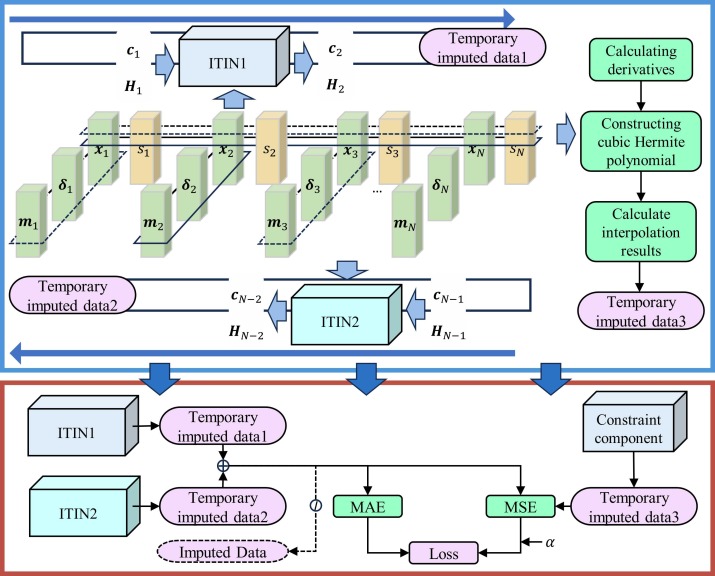
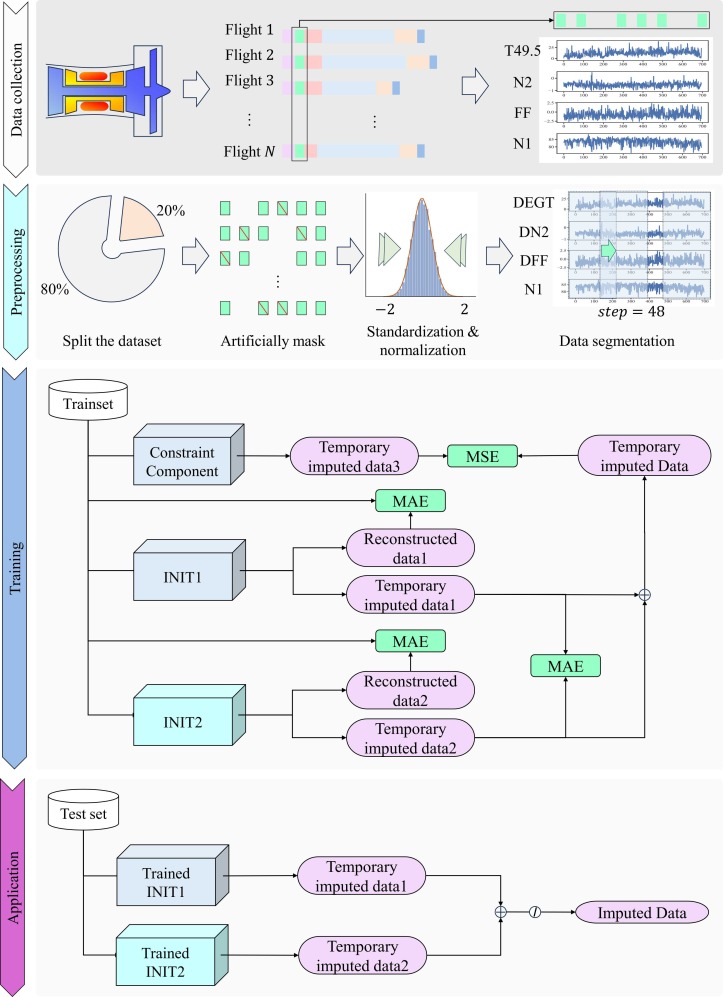
Fig. 4. Execution flow of the basic modules. The framework is a bidirectional INIT network, and the final result is jointly determined by two neural networks and an interpolation method.
Data Inputs and Constraints
Inputs
Flight performance data, sensor readings, time intervals, and missing masks.
Constraints
Piecewise Cubic Hermite Interpolation (PCHIP) is used to constrain the imputed value range.
Deployment Intent
High-accuracy imputation for real-world aero-engine degradation analysis.
Results
Evaluated on aero-engine degradation data imputation, with emphasis on imputation accuracy and stability under irregular sampling intervals.
Mean Imputation Error
2.12 ± 0.35
Lowest imputation error across all compared methods.
Imputation Stability
Low variance
Lower result fluctuation under irregular sampling intervals.
Data Recovery Accuracy
89.57 ± 3.71
Higher recovery capability compared with baseline methods.
What was validated
- Imputation accuracy: Significantly improved recovery accuracy for missing values in aero-engine degradation time series.
- Irregular-interval handling: Effectively adapts to varying time intervals between sensor readings.
- Robustness: Maintains low variance across repeated experiments.
- Cross-scenario applicability: Validated via comparative experiments on a wind turbine dataset.
Experimental Setup
Task
Missing data imputation for multi-class aero-engine degradation time series with irregular sampling intervals.
Baselines
GRU, GRU + Statistical Constraints, and traditional time-series imputation methods.
Metrics
Mean imputation error, recovery accuracy, and stability (mean ± standard deviation), with emphasis on recovery under challenging conditions.
Key claim validated
Improved stability and accuracy without increasing the sample size, supporting continual improvement.
Results Table
| Method | Imputation Error (mean ± std) | Recovery Accuracy (mean ± std) | Stability (variance) |
|---|---|---|---|
| GRU | 3.12 ± 0.75 | 80.71 ± 4.15 | High variance |
| GRU + Statistical Constraints | 2.78 ± 0.60 | 82.10 ± 4.00 | Moderate variance |
| Traditional Imputation | 3.50 ± 0.90 | 75.92 ± 5.20 | High variance |
| CUR-Estimator | 2.12 ± 0.35 | 89.57 ± 3.71 | Low variance |
Interpretation: CUR-Estimator achieves the highest imputation accuracy with the lowest variance.
Key Takeaways
- CUR-Estimator improves imputation accuracy without requiring additional samples.
- Stable performance across random splits indicates robustness for practical applications.
- Lower error variance yields more consistent predictions under irregular sampling.
Training Dynamics
Results of ten experiments on the C-MAPSS dataset using different methods, (a) MSE, (b) MAE.
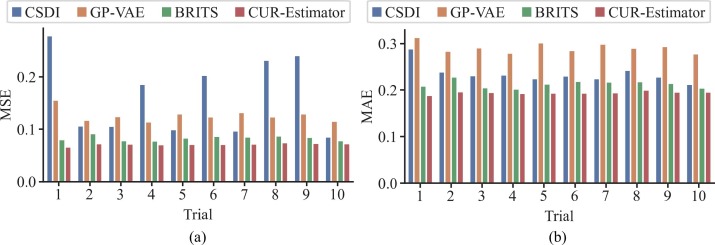
Fig. 9. Results of ten experiments on the C-MAPSS dataset using different methods, (a) MSE, (b) MAE.
Error Distribution
Bar charts and standard deviations of MSE and MAE under different SNRs.
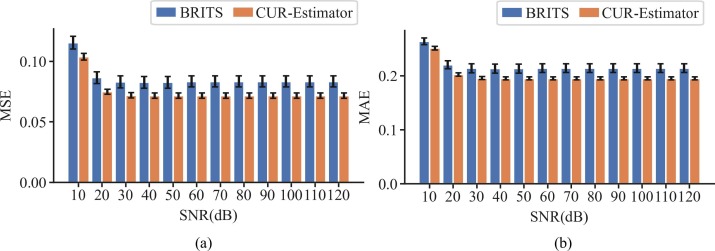
Fig. 10. Bar charts and standard deviations of MSE and MAE under different SNRs.
Figures for a quick read

Citation
If this work is useful, please cite the paper.
BibTeX
@article{wu2025cur,
  title   = {CUR-Estimator: Towards Accurate Missing Data Imputation in Aero-Engine Degradation Processes},
  author  = {Wu, Haoze and Zhong, Shisheng and Zhao, Minghang and Fu, Xuyun and Zhang, Yongjian and Fu, Song},
  journal = {Neurocomputing},
  volume  = {649},
  pages   = {130876},
  year    = {2025},
  doi     = {10.1016/j.neucom.2025.130876},
  url     = {https://doi.org/10.1016/j.neucom.2025.130876}
}
Contact
For collaboration, inquiries, or reproducibility requests, please contact the corresponding author.
Contact Email
Shisheng Zhong: zhongss#hit.edu.cnMinghang Zhao: zhaomh#hit.edu.cn
Acknowledgment
Supported by National Key R&D Program of China (2023YFB4302400), National Natural Science Foundation of China (No. 92360308).